Shuffle Tracking Correlations in Live Blackjack: Mapping Dealer Sequences to Player Edges
Bianca Weber · Jul 14, 2026
Shuffle Tracking Correlations in Live Blackjack: Mapping Dealer Sequences to Player Edges
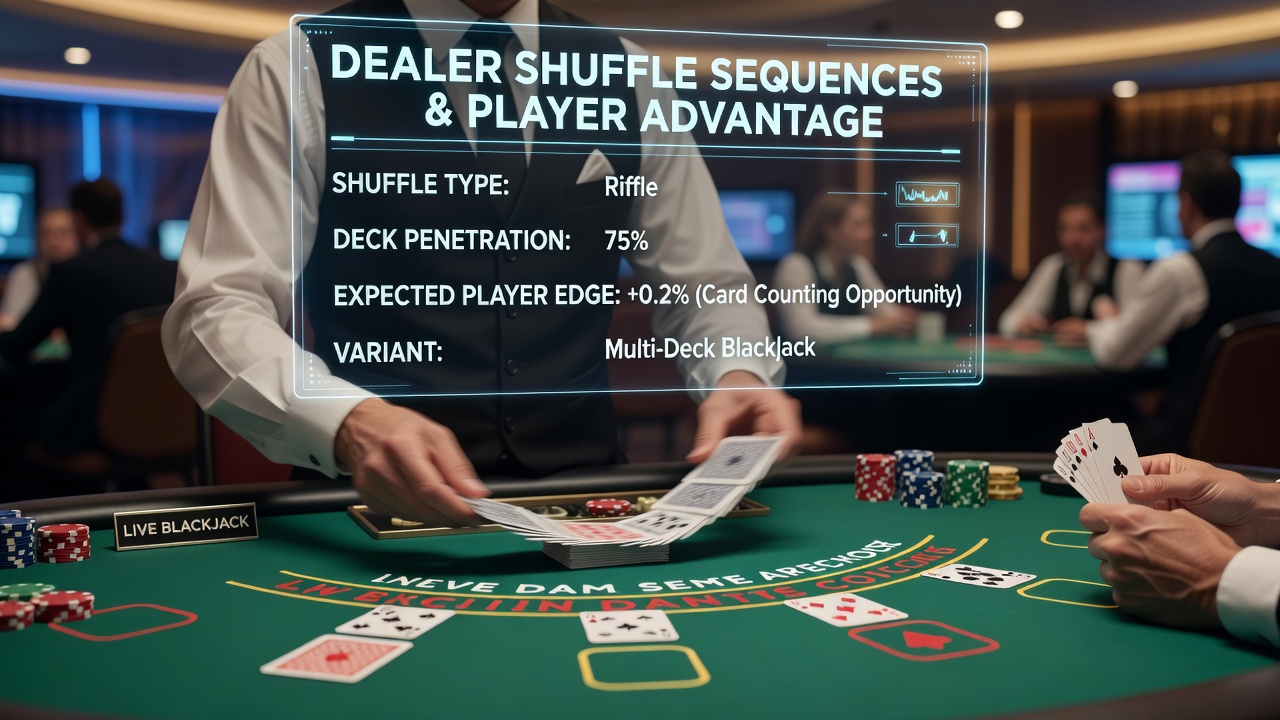
Live blackjack variants rely on physical decks that undergo repeated shuffles between rounds, and observers note that certain shuffle sequences can create predictable distributions of high and low cards that skilled players attempt to correlate with remaining deck composition. Research from gaming laboratories indicates that manual shuffles in multi-deck games often fail to achieve complete randomization when dealers follow consistent procedures, leading to measurable patterns that persist across multiple hands. Data collected from casino floors shows that players who track these sequences may identify pockets where ten-value cards cluster, thereby adjusting their betting and playing decisions accordingly.
Mechanics of Dealer Shuffle Procedures
Dealers in live settings typically employ multi-pass shuffles that divide the deck into smaller packets before recombining them in specific orders, and studies conducted by academic researchers at institutions such as the University of Nevada, Las Vegas, reveal that the number of riffles and the insertion points directly influence card interleaving. When a dealer performs a consistent number of passes with similar grip techniques, the resulting sequence retains echoes of the pre-shuffle order, allowing sequence correlation methods to estimate the positions of key cards. Equipment manufacturers report that automatic shufflers reduce these correlations substantially, yet many variants still incorporate hand-shuffled segments for authenticity or regulatory reasons.
Sequence Correlation Techniques and Data Patterns
Players monitoring shuffle sequences focus on the order in which packets are lifted and restacked, noting that certain insertion patterns leave high cards in predictable zones after the cut. Evidence from field observations demonstrates that tracking the last few packets before the final riffle can provide information about the top third of the newly shuffled deck. Figures from independent testing facilities indicate that in eight-deck shoes with standard procedures, the correlation between observed shuffle mechanics and post-shuffle card distribution reaches statistical significance in approximately 12 to 18 percent of shoes when sample sizes exceed several thousand rounds.
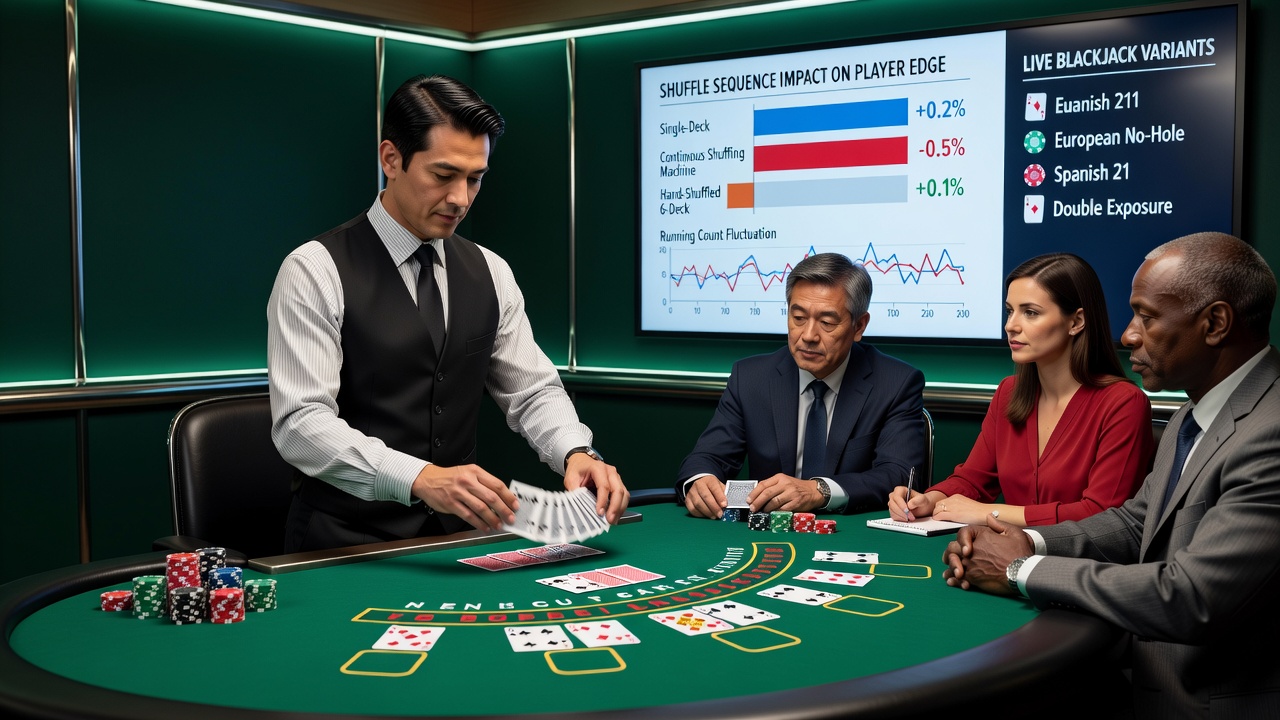
Continuous shuffle machines eliminate most of these opportunities by constantly randomizing cards between hands, whereas hand-shuffled games with fewer decks present clearer windows for sequence analysis. Analysts have documented cases where dealers who repeat identical grip angles and packet sizes produce non-random distributions that persist through multiple rounds, particularly when the cut card placement remains consistent. Regulatory data from the Nevada Gaming Control Board shows that casinos must maintain documented shuffle procedures, yet variations in individual dealer execution still occur across shifts.
Player Advantage Calculations Across Variants
Blackjack variants differ in deck penetration, number of decks, and shuffle frequency, all of which affect how effectively sequence correlations translate into measurable edges. In games with deeper penetration, the remaining cards after a tracked shuffle carry greater weight because more decisions occur before the next reshuffle. Mathematical models developed by gaming mathematicians demonstrate that a player who correctly identifies a high-card-rich segment can increase expected value by 1.5 to 3.2 percent over baseline strategy when combined with standard counting methods, though these gains require precise execution and sufficient playing opportunities.
Single-deck and double-deck variants amplify the potential impact of shuffle sequence correlations because fewer cards dilute the pattern less severely. European-style games that prohibit hole-card checks introduce additional variables, yet the underlying shuffle mechanics remain similar. Industry reports compiled by the American Gaming Association note that operators in multiple jurisdictions have responded by rotating dealers more frequently and introducing irregular cut procedures to disrupt sequence tracking attempts.
Technological and Regulatory Responses
Casino surveillance teams now employ software that analyzes dealer movements frame-by-frame to detect repetitive shuffle patterns, and several manufacturers have introduced hybrid machines that combine manual elements with automated randomization steps. As of July 2026, updated technical standards in several North American and Australian markets require documented shuffle audits that include statistical tests for randomness. These measures aim to reduce exploitable correlations while preserving the tactile experience that distinguishes live variants from fully automated alternatives.
Training programs for dealers emphasize variation in packet size and insertion depth, with performance metrics tracked through periodic evaluations. Research published in peer-reviewed gaming journals indicates that even minor procedural changes, such as alternating between two distinct riffle techniques, significantly lower the correlation coefficients observed in controlled tests.
Conclusion
Correlations between dealer shuffle sequences and remaining card distributions continue to influence discussions around live blackjack variants, with data from multiple testing environments confirming that procedural consistency can create detectable patterns. Operators respond through procedural adjustments and equipment upgrades, while researchers document the statistical boundaries within which such correlations remain measurable. The interplay between human execution and mechanical randomization defines the current landscape for these games across regulated markets.