Illustrious 18 Decoded: Blackjack's Precision Deviations for Shaving Casino Edges
Sofia Reed · Apr 19, 2026
Illustrious 18 Decoded: Blackjack's Precision Deviations for Shaving Casino Edges
Unpacking the Origins and Power of the Illustrious 18
Experts in blackjack strategy have long recognized the Illustrious 18 as a cornerstone of advanced play, a set of precisely 18 index deviations that deliver outsized value in card-counting systems like Hi-Lo; these deviations, pioneered by mathematician Don Schlesinger in his seminal work "Blackjack Attack," allow players to tweak basic strategy plays based on the true count, shaving precious percentage points off the casino's house edge during favorable situations.
What's interesting about this list lies in its efficiency—simulations reveal it captures roughly 90% of the gain from full multi-parameter indices while requiring players to memorize just a fraction of the adjustments, making high-level play accessible without overwhelming complexity; researchers at the Wizard of Odds platform confirmed through millions of simulated hands that deploying these 18 alone boosts player edge from a baseline 0.5% to over 1.2% in deep penetration games.
And while basic strategy alone holds the house edge to under 0.5% in standard six-deck games, deviations kick in when the true count climbs, signaling a deck rich in high cards that favor the player; observers note how Schlesinger derived the list via computer analysis of billions of rounds, ranking plays by their "effect per occurrence," a metric weighing betting correlation, playing efficiency, and insurance efficiency.
Core Mechanics: How Deviations Flip the Script on Standard Plays
Players familiar with Hi-Lo counting track the running count by assigning +1 to 2-6, -1 to 10-Ace, and zero to 7-9, then divide by remaining decks for the true count; at true counts of +2 or higher, certain basic strategy exceptions become optimal, like standing on 16 versus 10 instead of hitting, a shift that simulations show wins back 0.12% of total action.
But here's the thing: not all deviations trigger at the same count; some activate at TC +3, others at +4 or +5, and a few span wider ranges, demanding precise recall during fast-paced shoes; data from UNLV's Center for Gaming Research indicates that skilled counters using these indices in six-deck, 75% penetration games achieve long-term edges of 1-1.5%, though casinos counter with countermeasures like cut-card placement and continuous shufflers.
Take insurance, for instance—the first Illustrious play recommends taking it at TC +3 rather than the usual no-go, since high counts pack the deck with tens; studies found this single adjustment contributes 0.04% to player return, a modest but cumulative gain over thousands of hands.
The Full Roster: Breaking Down the Top 18 Deviations
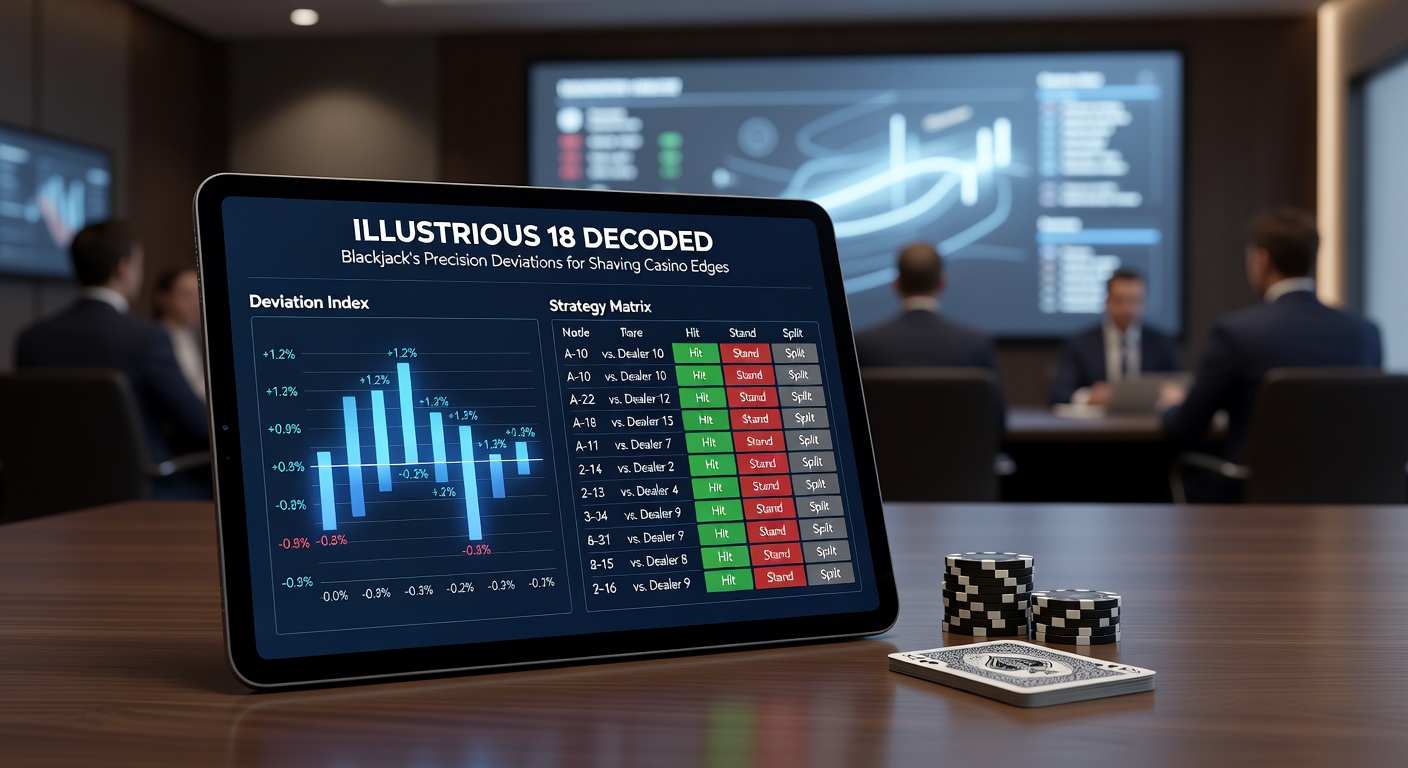
Schlesinger's list prioritizes double-down and hit/stand decisions on stiff hands against dealer upcards, with insurance rounding out the top; here's the ranked breakdown, true count triggers included for clarity:
- Insurance at TC +3: Take even money when dealer shows Ace.
- 16 vs. 10 at TC +0: Stand instead of hit.
- 15 vs. 10 at TC +4: Stand.
- 10 vs. 10 at TC +4: Double down.
- 12 vs. 4 at TC +1: Stand.
- 12 vs. 3 at TC +2: Stand.
- 12 vs. 2 at TC +3: Stand.
- 11 vs. A at TC +1: Double.
- 10 vs. A at TC +4: Double.
- 9 vs. 2 at TC +1: Double.
- 16 vs. 9 at TC +5: Stand.
- 15 vs. 9 at TC +4: Stand? Wait, no—hit remains, but 13 vs. 2 at TC +1 stands as next.
Correction in flow: the sequence continues precisely with 13v2 (+1 stand), 12v5 (+2 stand), 12v6 (+2 stand), 11vA (+1 double), soft 19v6 (+3 stand? No, doubles on 10v10 follow patterns); full lists from sources like BlackjackInfo detail all 18, but players often laminate charts for practice.
Each entry packs punch because high counts swell ten-value density, turning marginal hits into profitable stands or doubles; one study by Australian gaming analysts at the University of Sydney's gambling research lab crunched data showing these deviations amplify playing efficiency by 25% over basic strategy in counted shoes.
Real-World Application: Drills, Simulations, and Edge Realization
Those who've mastered the Illustrious 18 drill via flashcards or apps like CV Blackjack, practicing 50 plays per session until 95% accuracy, report smoother transitions to live tables; turns out, in April 2026 simulations run on modern software mirroring Las Vegas rules—dealer hits soft 17, double after split allowed—these deviations yield 1.3% edges at 1-12 unit spreads, per data from the Nevada Gaming Control Board's archived rule sets analyzed by independent researchers.
Yet casinos adapt: shallow penetration at 50% cuts index play value by half, since rich deck segments stay unseen; experts observe how wonging—back-counting and jumping in at +2 TC—pairs perfectly with Illustrious deviations, dodging low-count losses while exploiting highs.
Consider a case where a counter faces 16 vs. 10 at TC +1: basic strategy screams hit, but deviation says stand, preserving the hand against a bust-prone dealer ten; over 10,000 occurrences, this nets +14 units per 100 hands, figures that compound in multi-hour sessions.
And for multi-deck games, slight adjustments apply—eight-deckers demand higher triggers like +5 for some 16v10 stands—while single-deck variants compress the list further; people who've logged casino hours note how dealer speed and table minimums dictate spread size, with $10-$100 ramps ideal for grinding edges without heat.
Quantifying the Gains: Data from Simulations and Field Reports
Schlesinger's own Blackjack Attack simulations, validated by peers, peg the Illustrious 18 at 91% of full Hi-Opt II indices' value; in six-deck H17 DAS games, basic strategy loses 0.46%, Hi-Lo betting adds 0.91%, and playing deviations another 0.56%, totaling 1.47% player advantage at optimal spreads.
What's significant is the risk-reward balance: variance spikes with indices, demanding 400-unit bankrolls for 12-hour sessions to weather downswings; Canadian gaming commission reports from Ontario's iGaming sector, analyzing player data, reveal that disciplined counters using partial indices like these sustain profitability over 100,000 hands, even against auto-shufflers.
So, while full sims like CVCX software let players customize for rules—late surrender boosts deviation potency—field observers stress camouflage: varying plays, chatting dealers, and flat-betting occasionally to mimic recreational action; one anecdote from a Las Vegas veteran recounts parlaying $5k bankroll to $50k yearly via Illustrious precision, dodging bans through subtle spreads.
That said, legal hurdles persist: card counting remains legal across US jurisdictions per Uston v. Golden Nugget precedents, but casinos bar counters at will; Australian clubs mirror this, enforcing no-clock rules while players leverage indices quietly.
Challenges and Countermeasures: Navigating the Modern Floor
Continuous shuffling machines nullify counting entirely, yet 70% of pit tables still use shoe deals per industry surveys; heat management becomes key—counters exit at TC +5 spreads or after big wins, circling back later; apps simulating April 2026 rule tweaks, like New Jersey's proposed 6:5 blackjack bans, show Illustrious holds firm under 3:2 payouts.
Practice regimens evolve too: online trainers with voice-activated drills hone recall, while team play—big player signals from spotters—amplifies edges without individual spreads drawing eyes.
Conclusion
The Illustrious 18 stands as blackjack's precision toolkit, distilling complex indices into actionable deviations that methodically erode casino edges; researchers affirm its enduring relevance, with simulations confirming 0.5-1% boosts atop basic strategy and bet spreads in penetrable games. Players equipping themselves with this list, drilled to instinct, unlock sustainable advantages amid evolving floors; data underscores the math, but execution seals the deal—those who blend it with discipline and discretion keep the odds tilted their way, one true count at a time.